Nina Taylor
Choosing the right fishing rod can feel as complex as predicting fish behavior. One of the fundamental decisions anglers face is selecting between a 1-piece and a 2-piece rod. Both have dedicated followers and distinct advantages, but which one truly suits your fishing style, storage situation, and performance expectations? This decision isn’t just about convenience; it can influence sensitivity, casting, and the overall feel of your setup. Let’s dive deep into the nuances of 1-piece and 2-piece fishing rods to help you determine the best fit for your angling adventures.
Understanding the Basics: What Sets Them Apart?
Before we weigh the pros and cons, let’s define our contenders. A 1-piece fishing rod, as the name implies, consists of a single, continuous blank from the butt to the tip. There are no joints or connections along its length. This unified construction is often associated with optimal performance characteristics by purists.
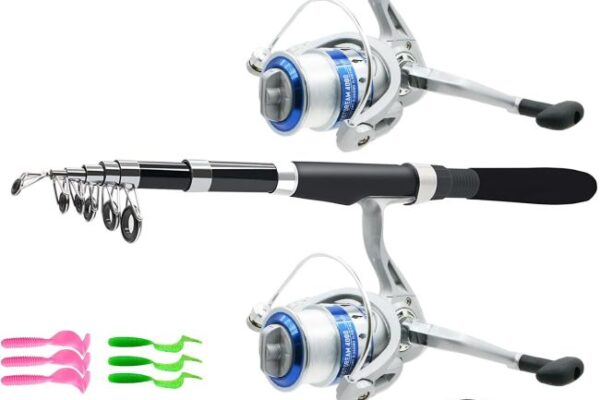
A 2-piece fishing rod, conversely, is designed to break down into two separate sections, typically near the middle. These sections connect via a joint called a ferrule – usually, the top section (tip section) slides over or into the bottom section (butt section). This design primarily addresses the challenges of transporting and storing longer rods. Variations like 3-piece, 4-piece, or even telescopic rods offer further portability, especially popular as dedicated travel rods.
The Case for 1-Piece Rods: Sensitivity and Seamless Power
For anglers who prioritize the ultimate in sensitivity and uninterrupted performance, the 1-piece rod often reigns supreme. Its single-blank construction means vibrations from a subtle bite, or the feel of the lure interacting with the bottom structure, travel directly to your hand without interruption. There’s no ferrule joint to potentially dampen these signals or create a “dead spot” in the rod’s action. This enhanced sensitivity can be crucial for techniques like drop-shotting, jigging, or finesse fishing where detecting light takes is paramount.
Furthermore, the seamless design contributes to a more consistent and natural flex or “action” throughout the rod’s length when casting or fighting a fish. Many anglers believe this leads to slightly better casting accuracy and a more fluid power transfer when setting the hook or battling a strong opponent. Because there’s no joint, there’s also theoretically one less potential point of failure, contributing to a perception of superior strength and durability, particularly in high-strain situations. Many high-end, technique-specific rods, especially in the bass fishing world, are exclusively offered in 1-piece configurations, reflecting the preference among serious anglers for uncompromised performance.
The Appeal of 2-Piece Rods: Convenience Meets Modern Performance
The most undeniable advantage of a 2-piece rod is its practicality. Transporting a 7-foot or longer 1-piece rod can be a significant hassle, especially in smaller cars, apartments, or when hiking through dense brush to reach a remote fishing spot. 2-piece rods break down easily, fitting into car trunks, closets, or even backpacks, making them incredibly convenient for anglers on the go, those with limited storage space, or anyone who travels frequently to fish. This portability opens up fishing opportunities that might be impractical with a cumbersome 1-piece rod.
Historically, 2-piece rods were often seen as inferior in terms of sensitivity and strength due to the ferrule joint. However, modern fishing rod technology has made remarkable strides. High-quality 2-piece rods from reputable manufacturers now feature advanced ferrule designs that are incredibly strong, lightweight, and designed to minimize impact on the rod’s action and sensitivity. Many experienced anglers report that the difference in feel between a premium 1-piece and its 2-piece counterpart is negligible for most applications. While a slight difference might still exist, especially in ultra-sensitive setups, the convenience factor often outweighs this minor trade-off for a vast number of fishermen. Plus, the ability to break the rod down can be advantageous when navigating thick shoreline vegetation.
Related: How to Store Fishing Rods: Guide for Every Angler
Factors to Consider When Choosing: Tailoring the Rod to You

The “best” rod isn’t universal; it depends entirely on your individual circumstances and fishing habits. Consider these factors:
- Fishing Style and Target Species: If your primary techniques rely heavily on feeling the slightest nibble (e.g., vertical jigging for walleye, finesse bass techniques), the enhanced sensitivity of a high-quality 1-piece rod might offer a slight edge. For techniques like trolling, casting larger lures, or general-purpose fishing where pinpoint sensitivity is less critical, a good 2-piece rod will likely perform admirably.
- Portability and Storage Needs: This is often the deciding factor. Do you drive a small car? Live in an apartment with limited space? Hike or fly to your fishing destinations? If yes, the convenience of a 2-piece (or multi-piece) rod is almost indispensable. If you have a truck or boat with ample rod storage and primarily fish locally, a 1-piece might be perfectly manageable.
- Budget and Performance Expectations: While excellent 2-piece rods exist across price points, the very highest echelon of performance-focused rods (like top-tier tournament bass rods) are often only made in 1-piece versions. However, you can find incredibly capable and sensitive 2-piece rods from reputable brands like St. Croix, Shimano, Fenwick, and Daiwa that offer fantastic performance without the premium price tag of the absolute elite 1-piece models. Don’t assume 2-piece automatically means lower quality, especially in mid-range and higher offerings.
- Sensitivity vs. Convenience Trade-off: Ultimately, it boils down to priorities. Are you willing to sacrifice some convenience for potentially maximal sensitivity and seamless action (1-piece)? Or does the ease of transport and storage offered by a 2-piece outweigh any subtle difference in feel you might (or might not) perceive?
Related: The Effects of Rod Length on Casting Distance and Accuracy
Are Modern 2-Piece Rods Catching Up?
Absolutely. The gap between high-quality 1-piece and 2-piece rods has narrowed significantly thanks to advancements in materials (like higher modulus graphite) and ferrule technology. Modern ferrules are designed to create a near-seamless connection, improving strength, reducing weight imbalances, and allowing the rod’s action to flow more naturally through the joint. Manufacturers invest heavily in ensuring their multi-piece rods perform comparably to their single-piece siblings. While a physicist might argue that any interruption in the blank must affect vibration transmission, in practical fishing terms, the difference in well-made rods is often imperceptible to many anglers.
People Also Ask (FAQs)
-
Are 1-piece rods always more sensitive than 2-piece rods?
- Theoretically, yes, as the blank is uninterrupted. However, with modern, high-quality 2-piece rods, the difference in sensitivity can be very minimal and often unnoticeable to the average angler. Factors like blank material, quality, and line type often have a greater impact on overall sensitivity.
-
Do 2-piece rods break easily at the joint?
- Not typically, especially with quality rods. Modern ferrules are very strong. Breakage is more often linked to cheap materials, manufacturing defects, or user error (like improper assembly, damage during transport, or “high-sticking” – bending the rod at too sharp an angle while fighting a fish). Always ensure the sections are firmly seated before fishing.
-
Can I travel easily with a 1-piece rod?
- It depends on the rod length and your mode of transport. Shorter 1-piece rods (under 6’6″) might fit in some vehicles, but longer rods (7ft+) are usually difficult to transport in cars and impossible for air travel without specialized (and often expensive) rod tubes. 2-piece or multi-piece travel rods are far more convenient for travel.
-
Are high-end fishing rods usually 1-piece or 2-piece?
- Many top-tier, technique-specific rods, particularly for bass fishing, are offered primarily as 1-piece models to maximize sensitivity and performance. However, excellent high-quality 2-piece rods are readily available from major manufacturers across various price points.
-
Does the joint on a 2-piece rod affect casting?
- On older or lower-quality rods, the joint could create a stiff or “dead” spot affecting the rod’s loading and casting. Modern, well-designed ferrules minimize this, allowing for smooth, efficient casting comparable to 1-piece rods of similar specs. Occasional twisting at the ferrule can occur, requiring a quick readjustment.
Related: Why Aren’t Fish Biting My Lure? 7 Mistakes Anglers Make
Conclusion: The Final Cast
There’s no single “winner” in the 1-piece vs. 2-piece debate. The optimal choice hinges on balancing performance characteristics with practical needs.
Choose a 1-piece rod if:
- You prioritize the absolute maximum sensitivity and seamless action.
- Transport and storage space are not significant concerns.
- You are targeting high-end, technique-specific rods often only available in this configuration.
Choose a 2-piece rod if:
- Portability, ease of transport, and storage are major priorities.
- You travel frequently to fish or have limited space.
- You want a versatile rod that performs well across various techniques without demanding maximum sensitivity.
- You appreciate the convenience and recognize that modern 2-piece rods offer excellent performance.
Consider your primary fishing scenarios, how you transport your gear, and your budget. Test both types if possible. Ultimately, the best fishing rod is the one that feels right in your hands and perfectly complements your unique angling lifestyle. Whether it’s a seamless single blank or a conveniently sectioned companion, the right choice will help you make the most of your time on the water.